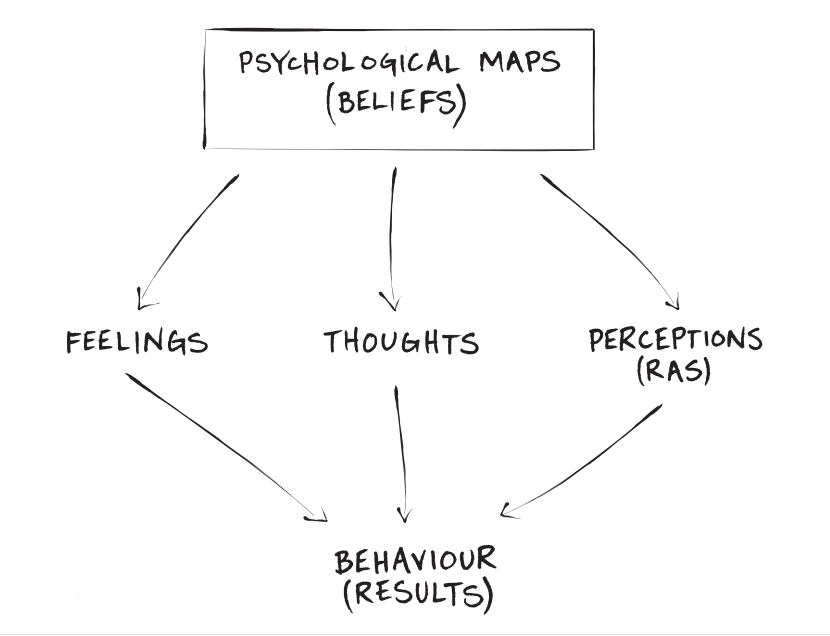
Let’s take a little time to unpick the ideas behind this.
Thoughts
Take a couple of minutes to reflect upon the following questions:
◆ What thoughts do you have when something goes wrong in your life?
◆ What thoughts do you have when something pleasurable happens?
◆ What thoughts do you have when learning something new?
The thoughts that you have in response to these and other situations are sometimes called ‘self-talk’. Different people will have different thoughts in similar situations. The thoughts arise from the interaction between your beliefs (maps) and the situations you find yourself in. For example, if you have a low level of confidence and you are asked to take on a challenge your self-talk will tend to be negative. You will think about the reasons why you cannot rise to the challenge. You may have thoughts anticipating failure. Likewise, you may be very creative at thinking of reasons why you should not take on the challenge.
Ironically, all this psychological activity confirms your belief that you are not up to the job. It is a vicious spiral. A negative self-fulfilling prophecy. These thinking patterns will have a direct impact upon your performance and the results you get in life.
Feelings
A simple and very useful way of understanding our feelings and emotions is by using the concept of ‘the comfort zone’. This may be thought of as a psychological area or zone. Within this zone are all the thoughts and activities that allow a person to feel comfortable.
The thoughts, activities and behaviours that cause unpleasant feelings lie outside the comfort zone. The more a person moves away from familiar, comfortable activities the greater their discomfort.
There are many ways the discomfort is experienced emotionally. People may fear things outside their comfort zone. They may be anxious about certain thoughts or behaviours. They may speak of being ‘stressed out’. When a person moves outside their comfort zone they may experience a wide range of physical responses, such as:
◆ panic attacks
◆ poor physical co-ordination
◆ palpitations
◆ memory loss
◆ nausea
◆ perspiration
◆ dry mouth
◆ low energy
◆ fainting.
A common experience of going outside a comfort zone comes at the time of examinations. The student may be very knowledgeable. They may have successfully completed essays and projects. Yet when they have to perform under examination conditions they move outside their comfort zone. This can result in them being nauseous and fuzzy headed and suffering memory loss. The bottom line is that they will perform poorly.
Conversely, a less gifted student whose comfort zone includes doing exams will perform at the top of their capability range and may outperform a cleverer student. We see here that EI influences results as much as, possibly more than, IQ.
In the case of the two students, the key point is why one student feels comfortable and another does not? We can trace this back to the psychological maps they possess. If old maps that deliver poor results can be changed, then life can be improved.
Perceptions
We are able to take in and process information through our five senses. The visual, auditory, and kinesthetic (touch) are the dominant ones. However, at times both smell and taste may be very important. Each of us has a huge capacity to take in masses of information. Indeed, there could be a danger of overload. Try the following activity:
1 Notice your eyes picking up these words on the page.
2 Also notice what is in your peripheral vision.
3 Now become aware of all the sounds around you – near and far.
4 What lights and colours and shades can you see as you read?
5 How are your feet arranged? Can you feel the ground beneath them?
6 What is your body temperature?
7 Is your body temperature the same throughout your body?
8 Finally, think about 1–7 all at the same time!
Most people would respond by saying they could not process this amount of information. Yet they are receiving these inputs. They just cannot consciously deal with it all at the same time. So how do we cope? Fortunately, we have a reticular activating system (RAS).
The RAS is part of a brain that acts as a filter. It makes us aware of things that are important to us while filtering out the less important stuff. How does the RAS know what is important? It uses our maps and beliefs. These set the priorities and then the RAS works on ‘autopilot’.
This process explains why people living near an airport will sleep through aeroplane take-offs and landings yet will be woken by the quieter cries of their baby. Here people believe that waking up for their child’s cry is important while waking for aeroplanes is not. It is by this process that we can filter out the noise of a party yet still hear someone saying our name or talking about something we value.
The RAS allows into our conscious mind information consistent with current beliefs. If it allowed contradictory information in a person would feel uncomfortable. So the RAS is designed to minimize these bad feelings. Conversely, it readily lets in information that supports a belief. The problem arises here if the person has a belief that holds them back – a belief that is based on their opinions rather than reality. Here the belief is an old map. It is like the child assuming the chairs exist where they do not.
If a person believes that they are boring they will only perceive information that may support that point of view. Any contrary evidence will be filtered out. The RAS will prevent the person from seeing or hearing any signs of people being interested in them. The evidence of their senses means that their beliefs are never changed. There is nothing provoking change.
© Managing yourself