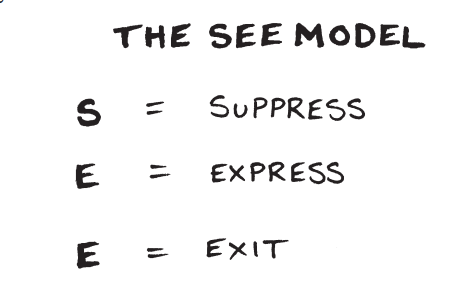
In many situations, a person may have a strong emotional reaction. One way they try and deal with it is via suppression. They attempt to push the feeling deeper inside themselves. There is a tendency to deny the feelings. An additional approach to suppression is to deaden the pain by using alcohol or drugs. While suppression may lead to some temporary relief, it may leave the underlying issues unchanged. This means the emotions are likely to re-emerge and require further suppression.
A second response to unwanted emotions takes an opposite approach to suppression. In this case, there is an emotional outpouring. This is, more often than not, seen in manifestations of anger, aggression, tantrums and sulking. Here the person is expressing their feelings. While people try to justify ‘letting off steam’, it usually ruins relationships and causes problems. The idea of it being ‘better out than in’ may provide the person with temporary relief. However, in most cases these outbursts repeat themselves. The expression does not lead to a permanent resolution. Furthermore, the expression of emotions often poisons relationships on a long-term basis.
A third and final common response is called Exit. When situations lead to destructive emotions, people may suppress or express them. To avoid this happening, some people choose to get away from the difficult situation. They may run away or leave the room or whatever it takes. There is also a tendency to avoid the situations where such emotions may arise. At times this is a sensible response. However, if you avoid places that are important to your life then it can become problematic.
While we tend to use the SEE model (see below), the outcomes are rarely fully adequate. So sometimes we try one method and if it does not work we redouble our efforts. Typical examples are drinking even more to deaden feelings or having even bigger emotional outbursts. Alternatively, people try one approach and then swing across and try another.
Fortunately, there is an alternative that works wonderfully for destructive emotions. This approach is called ‘letting go’ or ‘releasing’. There are several exponents of this approach. One of the most eminent is Dr Patricia Carrington, former lecturer at Princeton University. In her work as a clinical psychologist she recognized that people using the SEE model suffered from stress related illnesses, family relationship problems and depression.
The release approach encourages people to just ‘let go’ of a feeling. Instead of trying to do something with a feeling, the alternative is to allow the emotion to ‘float away’. Like the young monk in the story below, there is a tendency to hold on to emotions that harm us.
Once you have become aware of your emotions and feelings it is possible to determine whether they are constructive or destructive. In the latter case you now have the option of letting go of that emotion.
If it should return you will also be able to release it again. With time the process of releasing emotions can be done in seconds. It is time to take control and manage your emotions.
© Managing yourself