
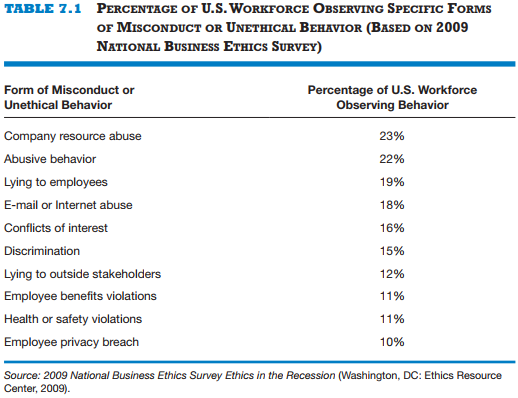
Of the employees who observed misconduct, 63 percent reported their observation to a supervisor or another authority in their firm. The 10 most common types of misconduct or unethical behavior observed by the employees surveyed are shown in the table.
While the percentage of employees who have observed misconduct or unethical behavior (49 percent) is discouraging, it’s encouraging that 63 percent of employees reported the behavior. According to the survey, the majority of employees also have a positive view of their leaders’ transparency and accountability. A total of 80 percent said they were satisfied with the information they were getting from top management about “what’s going on in my company.” Seventy-four percent said they trusted that top management would keep their promises and commitment. A full 89 percent said top management talks about the importance of workplace ethics and “doing the right thing.” And when asked if they believe top managers would be held accountable if caught violating the organization’s ethical standards, 82 percent said yes. Overall, these numbers are heartening.
In analyzing the results of its survey, the Ethics Resource Center concluded that the most important thing an organization can do to combat the figures its study revealed is to establish a strong ethical culture. But strong ethical cultures don’t emerge by themselves. It takes entrepreneurs who make ethics a priority and organizational policies and procedures that encourage ethical behavior (and punish unethical behavior) to make it happen. The following are specific steps that an entrepreneurial organization can take to build a strong ethical culture.
Lead by Example: Leading by example is the most important thing that any entrepreneur, or team of entrepreneurs, can do to build a strong ethical culture in their organization. This is being done in many organizations, as indicated by the transparency and accountability figures shown previously. Three things are particularly important in building a strong ethical culture in a firm:
1. Leaders who intentionally make ethics a part of their daily conversations and decision making
2. Supervisors who emphasize integrity when working with their direct reports
3. Peers who encourage each other to act ethically
In companies where these attributes are present, a stronger ethical culture exists. This reality demonstrates the important role that everyone involved with a start-up plays in developing a strong ethical culture for their firm.
Establish a Code of Conduct: A code of conduct (or code of ethics) is a formal statement of an organization’s values on certain ethical and social issues. The advantage of having a code of conduct is that it provides specific guidance to managers and employees regarding expectations of them in terms of ethical behavior.
In practice, some codes of conduct are very specific. Other codes of conduct set out more general principles about an organization’s beliefs on issues such as product quality, respect for customers and employees, and social responsibility. The 2009 National Business Ethics Survey, mentioned previously, found that employees are much more likely to report ethical misconduct in their firms when specific compliance mechanisms like codes of conduct are in place.
Implement an Ethics Training Program: Firms also use ethics training programs to promote ethical behavior. Ethics training programs teach business ethics to help employees deal with ethical dilemmas and improve their overall ethical conduct. An ethical dilemma is a situation that involves doing something that is beneficial to oneself or the organization, but may be unethical. Most employees confront ethical dilemmas at some point during their careers.
Ethics training programs can be provided by outside vendors or can be developed in-house. For example, one organization, Character Training International (CTI), provides ethics training programs for both large organizations and smaller entrepreneurial firms. The company offers a variety of ethics-related training services, including on-site workshops, speeches, a train-the-trainer curriculum, videos, and consulting services. A distinctive attribute of CTI is its focus on the moral and ethical roots of workplace behavior. In workshops, participants talk about the reasons behind ethical dilemmas and are provided practical, helpful information about how to prevent problems and how to deal appropriately with the ethical problems and temptations that do arise. The hope is that this training will significantly cut down on employee misconduct and fraud and will increase morale.
In summary, ethical cultures are built through both strong ethical leadership and administrative tools that reinforce and govern ethical behavior in organizations. Building an ethical culture motivates employees to behave ethically and responsibly from the inside out, rather than relying strictly on laws that motivate behavior from the outside in. There are many potential payoffs to organizations that act and behave in an ethical manner.
The strength of a firm’s ethical culture and fortitude is put to the test when it faces a crisis or makes a mistake and has to determine how to respond. Amazon.com provides an example of this. In April 2011, Amazon.com’s Web hosting service experienced a massive glitch, which led to a shutdown of its servers for several days. The shutdown caused many of its customers’ Web sites, including popular sites like Foursquare, HootStuite, Reddit, and Quora, to go down and in some cases lose data. In addition to its e-commerce site, Amazon.com provides Web services for businesses. Amazon.com publicly apologized for the glitch and took full responsibility. It also offered a credit to those affected. At the end of a lengthy explanation of what led to the failure, Amazon.com said “Last, but certainly not least, we want to apologize. We know how critical our services to our customers’ businesses are, and we will do everything we can to learn from this event and use it to drive improvement across our services.” In addition to making technical changes, Amazon.com said it also would improve the way it communicates with customers. Some users were frustrated during the outage that they weren’t getting timely information from Amazon.com about when the outage would be fixed.
By showing contrition, a concern for its customers, and a commitment to do better next time, Amazon hopefully not only repaired its reputation with its users but showed the true nature of its corporate character.
© Entrepreneurship, Successfully Launching New Ventures