The way a firm sells and distributes its product dramatically affects a company’s marketing program. This effect means that the first decision a firm has to make is its overall approach to selling its product or service. Even for similar firms, the marketing mix can vary significantly, depending on the way the firms do business. For example, a software firm can sell directly through its Web site or through retail stores, or it can license its product to another company to be sold under that company’s brand name. A start-up that plans to sell directly to the public would set up its promotions program in a much different way than a firm planning to license its products to other firms. A firm’s marketing program should be consistent with its business model and its overall business plan.
Let’s look more closely at the 4Ps. In this section, we focus on the aspects of the 4Ps that are most relevant to entrepreneurial ventures.
1. Product
A firm’s product, in the context of its marketing mix, is the good or service it offers to its target market. Technically, a product is something that takes on physical form, such as an Apple iPhone, an electronic game, or a solar panel. A service is an activity or benefit that is intangible and does not take on a physical form, such as an airplane trip or advice from an attorney. But when discussing a firm’s marketing mix, both products and services are lumped together under the label “product.”
Determining the product or products to be sold is central to the firm’s entire marketing effort. The most important attribute of a product is that it adds value in the minds of its target customers. Let’s think about this by comparing vitamins with pain pills, as articulated by Henry W. Chesbrough, a professor at Harvard University:
We all know that vitamins are good for us and that we should take them. Most of us, though, do not take vitamins on a regular basis, and whatever benefits vitamins provide do not seem to be greatly missed in the short term. People therefore pay relatively very little for vitamins. In contrast, people know when they need a pain killer. And they know they need it now, not later. They can also tell quite readily whether the reliever is working. People will be willing to pay a great deal more for a pain reliever than they pay for a vitamin. In this context, the pain reliever provides a much stronger value proposition than does a vitamin—because the need is felt more acutely, the benefit is greater and is perceived much more quickly.
This example illustrates at least in part why investors prefer to fund firms that potentially have breakthrough products, such as a software firm that is working on a product to eliminate e-mail spam or a biotech firm that is working on a cure for a disease. These products are pain pills rather than vitamins because their benefits would be felt intensely and quickly. In contrast, a new restaurant start-up or a new retail store may be exciting, but these types of firms are more akin to a vitamin than a pain pill. The benefits of these businesses would not be felt as intensely.
As the firm prepares to sell its product, an important distinction should be made between the core product and the actual product. While the core product may be a CD that contains a tax preparation program, the actual product, which is what the customer buys, may have as many as five characteristics: a quality level, features, design, a brand name, and packaging. For example, TurboTax is an actual product. Its name, features, warranty, ability to upgrade, packaging, and other attributes have all been carefully combined to deliver the benefits of the product: helping people prepare their federal and state tax returns while getting the biggest refund possible. When first introducing a product to the market, an entrepreneur needs to make sure that more than the core product is right. Attention also needs to be paid to the actual product—the features, design, packaging, and so on that constitute the collection of benefits that the customer ultimately buys. Anyone who has ever tried to remove a product from a frustratingly rigid plastic container knows that the way a product is packaged is part of the product itself. The quality of the product should not be compromised by missteps in other areas.
The initial rollout is one of the most critical times in the marketing of a new product. All new firms face the challenge that they are unknown and that it takes a leap of faith for their first customers to buy their products. Some startups meet this challenge by using reference accounts. A reference account is an early user of a firm’s product who is willing to give a testimonial regarding his or her experience with the product. For example, imagine the effect of a spokesperson for Apple Inc. saying that Apple used a new computer hardware firm’s products and was pleased with their performance. A testimonial such as this would pave the way for the sales force of this new firm’s hardware, and the new firm could use it to reduce fears that it was selling an untested and perhaps ineffective product.
To obtain reference accounts, new firms must often offer their product to an initial group of customers for free or at a reduced price in exchange for their willingness to try the product and for their feedback. There is nothing improper about this process as long as everything is kept aboveboard and the entrepreneur is not indirectly “paying” someone to offer a positive endorsement. Still, many entrepreneurs are reluctant to give away products, even in exchange for a potential endorsement. But there are several advantages to getting a strong set of endorsements: credibility with peers, non-company advocates who are willing to talk to the press, and quotes or examples to use in company brochures and advertisements.
2. Price
Price is the amount of money consumers pay to buy a product. It is the only element in the marketing mix that produces revenue; all other elements represent costs. Price is an extremely important element of the marketing mix because it ultimately determines how much money a company can earn. The price a company charges for its products also sends a clear message to its target market. For example, Oakley positions its sunglasses as innovative, state-of-the art products that are both high quality and visually appealing. This position in the market suggests the premium price that Oakley charges.
If Oakley tried to establish the position described previously and charged a low price for its products, it would send confusing signals to its customers. Its customers would wonder, “Are Oakley sunglasses high quality or aren’t they?” In addition, the lower price wouldn’t generate the sales revenue Oakley requires to continuously differentiate its sunglasses from competitors’ products in ways that create value for customers.
Most entrepreneurs use one of two methods to set the price for their products: cost-based pricing or value-based pricing.
Cost-Based Pricing In cost-based pricing, the list price is determined by adding a markup percentage to a product’s cost. The markup percentage may be standard for the industry or may be arbitrarily determined by the entrepreneur. The advantage of this method is that it is straightforward, and it is relatively easy to justify the price of a good or service. The disadvantage is that it is not always easy to estimate what the costs of a product will be. Once a price is set, it is difficult to raise it, even if a company’s costs increase in an unpredicted manner. In addition, cost-based pricing is based on what a company thinks it should receive rather than on what the market thinks a good or service is worth. It is becoming increasingly difficult for companies to dictate prices to their customers, given customers’ ability to comparison shop on the Internet to find what they believe is the best bargain for them.
Value-Based Pricing In value-based pricing, the list price is determined by estimating what consumers are willing to pay for a product and then backing off a bit to provide a cushion. What a customer is willing to pay is determined by the perceived value of the product and by the number of choices available in the marketplace. Sometimes, to make this determination, a company has to work backwards by testing to see what its target market is willing to pay. A firm influences its customers’ perception of the value through positioning, branding, and the other elements of the marketing mix. Most experts recommend value-based pricing because it hinges on the perceived value of a product or service rather than cost-plus markup, which, as stated previously, is a formula that ignores the customer. A gross margin (a company’s net sales minus its costs of goods sold) of 60 to 80 percent is not uncommon in high-tech industries. An Intel chip that sells for $300 may cost $50 to $60 to produce. This type of markup reflects the perceived value of the chip. If Intel used a cost-based pricing method instead of a value-based approach, it would probably charge much less for its chips and earn less profit.
Most experts also warn entrepreneurs to resist the temptation to charge a low price for their products in the hopes of capturing market share. This approach can win a sale but generates little profit. In addition, most consumers make a price-quality attribution when looking at the price of a product. This means that consumers naturally assume that the higher-priced product is also the better-quality product. If a firm charges a low price for its products, it sends a signal to its customers that the product is low quality regardless of whether it really is.
A vivid example of the association between price and quality is provided by SmugMug, an online photo-sharing site that charges a $40-per-year base subscription fee. SmugMug, which is growing rapidly, has 300,000 paying customers and more than 1.3 billion photos stored. What’s interesting about the company is that most of its competitors, including Shutterfly and Flickr, offer a similar service for free. Ostensibly, the reason SmugMug is able to charge a fee is that it offers higher levels of customer service and has a more user-friendly interface (in terms of how you view your photos online) than its competitors. But the owners of SmugMug feel that its ability to charge goes beyond these obvious points. Some of the free sites have closed abruptly, and their users have lost photos. SmugMug, because it charges, is seen as more reliable and dependable for the long term. (Who wants to lose their photos?) In addition, the owners believe that when people pay for something, they innately assign a higher value to it. As a result, SmugMug users tend to treat the site with respect, by posting attractive, high-quality photos that are in good taste. SmugMug’s users appreciate this facet of the site, compared to the free sites, where unseemly photos often creep in.
The overarching point of this example is that the price a company is able to charge is largely a function of (1) the objective quality of a product or service and (2) the perception of value that you create in the minds of your customers relative to competing products in the marketplace. These are issues a firm should consider when developing its positioning and branding strategies.
3. Promotion
Promotion refers to the activities the firm takes to communicate the merits of its product to its target market. Ultimately, the goal of these activities is to persuade people to buy the product. There are a number of these activities, but most start-ups have limited resources, meaning that they must carefully study promotion activities before choosing the one or ones they’ll use. Let’s look at the most common activities entrepreneurs use to promote their products.
Advertising Advertising is making people aware of a product in hopes of persuading them to buy it. Advertising’s major goals are to do the following:
• Raise customer awareness of a product
• Explain a product’s comparative features and benefits
• Create associations between a product and a certain lifestyle
These goals can be accomplished through a number of media including direct mail, magazines, newspapers, radio, the Internet, television, and billboard advertising. The most effective ads tend to be those that are memorable and support a product’s brand. However, advertising has some major weaknesses, including the following:
• Low credibility
• The possibility that a high percentage of the people who see the ad will not be interested
• Message clutter (meaning that after hearing or reading so many ads, people simply tune out)
• Relative costliness compared to other forms of promotions
• The perception that advertising is intrusive
Because of these weaknesses, most start-ups do not advertise their products broadly. Instead, they tend to be very frugal and selective in their advertising efforts or engage in hybrid promotional campaigns that aren’t advertising per se but are designed to promote a product or service.
Along with engaging in hybrid promotional campaigns, many start-ups advertise in trade journals or utilize highly focused pay-per-click advertising provided by Google, Bing, or another online firm to economize the advertising dollars. Pay-per-click advertising represents a major innovation in advertising and has been embraced by firms of all sizes. Google has two payper-click programs—AdWords and AdSense. AdWords allows an advertiser to buy keywords on Google’s homepage (www.google.com), which triggers text-based ads to the side (and sometimes above) the search results when the keyword is used. So, if you type “soccer ball” into the Google search bar, you will see ads that have been paid for by companies that have soccer balls to sell. Many advertisers report impressive results utilizing this approach, presumably because they are able to place their ads in front of people who are already searching for information about their product. Google’s other payper-click program is called AdSense. It is similar to AdWords, except the advertiser’s ads appear on other Web sites instead of Google’s homepage. For example, an organization that promotes soccer might allow Google to place some of its client’s ads on its Web site. The advertiser pays on a pay-for-click basis when its ad is clicked on the soccer organization’s site, just like it does with AdWords. Google shares the revenue generated by the advertisers with the sponsoring site. Yahoo! and Microsoft’s programs, which are very similar to Google’s, are called Yahoo! Search Marketing and Microsoft adCenter (showing ads on Bing), respectively.
As an aside, the Google AdSense program allows people who know a lot about a particular topic to launch a Web site, populate it with articles, tips, videos, and other useful information and make money online by essentially selling access to the people attracted to the Web site. For example, Tim Carter, a well-known columnist on home repair, has a Web site named Ask the Builder (www.askthebuilder.com). Information and instructions on all types of home building projects and repair are available on this Web site, as are links to areas that focus on specific topics, like air conditioning, cabinets, deck construction, and plumbing. Clicking any one of these areas brings up AdSense ads that deal with that specific area. All together, the site has hundreds of AdSense ads. Carter is able to do this and still attract large numbers of visitors because the information he provides is good and helpful. He might also believe that his ads, in a certain respect, add valuable content to the site. If someone is looking at the portion of his site that deals with how to construct a deck, he or she might actually appreciate seeing ads that point to Web sites where books and blueprints for building decks are available.
Another medium for advertising, which is growing in popularity, is to advertise through social media sites, like Facebook. The advantage of Facebook, in particular, is that it allows companies to deliver highly targeted ads, based on where people live and how they describe themselves on their Facebook profiles. For example, a company that sells licensed sports apparel for the Boston Red Sox can deliver a highly targeted ad to the people most likely to buy its products. The company could deliver ads exclusively to men who live in Massachusetts and cite the “Red Sox” in their Facebook profiles. Any company can identify its ideal potential customer and deliver targeted Facebook ads in the same manner.
Typically, for start-up firms, advertisements are the most effective if they’re part of a coordinated marketing campaign. For example, a print ad might feature a product’s benefits and direct the reader to a Web site or Facebook page for more information. The Web site or Facebook page might offer access to coupons or other incentives if the visitor fills out an information request form (which asks for name, address, and phone number). The names collected from the information request form could then be used to make sales calls.
Steps Involved in Putting Together an Advertisement
Sept 1: Identify the purpose of the ad: Clearly identify one or more purposes that you expect the advertisement to achieve
Step 2: Determine the target audience Identify who you want to see the ad
Step 3: Select a medium: Select a medium for the ad, such as television, radio, or newspaper
Step 4: Create the ad: Create an ad that is appropriate for your audience, product, and budget
Step 5: Select a place and time for the ad to appear Select the specific place and the specific time of day (or location in a newspaper) for an ad to appear
Step 6: Fulfill expectations: Make sure to have enough product on hand (or people to take orders) if the ad is successful
Public Relations One of the most cost-effective ways to increase the awareness of the products a company sells is through public relations. Public relations refer to efforts to establish and maintain a company’s image with the public. The major difference between public relations and advertising is that public relations is not paid for—directly. The cost of public relations to a firm is the effort it makes to network with journalists, blog authors, and other people to try to interest them in saying or writing good things about the company and its products. Several techniques fit the definition of public relations.
Many start-ups emphasize public relations over advertising primarily because it’s cheaper and helps build the firm’s credibility. In slightly different words, it may be better to start with public relations than advertising because people view advertising as the self-serving voice of a company that’s anxious to make a sale. A firm’s public relations’ effort can be oriented to telling the company’s story through a third party, such as a magazine or a newspaper. If a magazine along the lines of Inc., Entrepreneur or Business Week publishes a positive review of a new company’s products, or a company is profiled in a prominent blog, consumers are likely to believe that those products are at least worth a try. They think that because these magazines and blogs have no vested interest in the company, they have no reason to stretch the truth or lie about the usefulness or value of a company’s products. Technology companies, for example, that are featured on TechCrunch or Mashable, two popular technology blogs, typically see an immediate spike in their Web traffic and sales as a result of the mention.
There are many ways in which a start-up can enhance its chances of getting noticed by the press, a blogger, or someone who is influential in social media. One technique is to prepare a press kit, which is a folder that contains background information about the company and includes a list of its most recent accomplishments. The kit is normally distributed to journalists and made available online. Another technique is to be present at industry trade shows and other events. A trade show is an event at which the goods or services in a specific industry are exhibited and demonstrated. Members of the media often attend trade shows to get the latest industry news. For example, the largest trade show for consumer electronics is International CES, which is held in Las Vegas every January. Many companies wait until this show to announce their most exciting new products. They do this in part because they have a captive media audience that is eager to find interesting stories to write about.
PUBLIC RELATIONS TECHNIQUES
• Press release An announcement made by a firm that is circulated to the press. Start-ups typically circulate a press release when something positive happens, such as the launch of a new product or the hiring of a new executive.
• Traditional media coverage Any coverage in print or broadcast media. In most cases, start-ups try to cultivate media coverage, as long as it is positive.
• Social media coverage Start-ups use social media (Facebook, Twitter) as a way of communicating and building rapport with customers, and also covet positive mentions in the social media efforts of others. For example, a positive mention by someone who posts on Twitter and has a large number of followers can positively impact a start-up.
• Articles in industry press and periodicals Articles in industry press and periodicals are particularly coveted because they are read by people already interested in the industry in which the start-up is participating.
• Blogging Companies benefit from blogging in three ways: First, by writing their own blog, as a way of building rapport with customers and the general public. Second, by commenting on entries contained in other companies’ or people’s blogs. Third, by contacting bloggers and asking them to comment on a company’s product or service. The general rule of thumb in blogging is that thoughtful and substantive contributions are fine. Outwardly talking about the merits of a company’s products is inappropriate, unless it’s on the company’s own blog.
• Monthly newsletter Many companies stay in touch with their potential target audience by producing and distributing a monthly or quarterly newsletter. Along with containing updates on a firm’s products and services, the newsletter should contain more general information of interest to the reader. Companies should avoid sending out newsletters that simply brag about their products. These types of newsletters are often seen as too self-serving.
• Civic, social, and community involvement Start-ups often try to create a positive image of their organization by sponsoring local events or asking their employees to be involved in civic clubs such as the Chamber of Commerce or the Rotary Club.
Social Media Social media consists primarily of blogging and establishing a presence and connecting with customers and others through social networking sites like Facebook or Twitter. Many of the new ventures featured in this book are active users of social media. A good example is ModCloth, ModCloth maintains an active blog, has three separate Twitter accounts (one for general product information, one that is more fashion oriented, and one for recruiting), and maintains an energetic Facebook page.
The idea behind blogs is that they familiarize people with a business and help build an emotional bond between a business and its customers. ModCloth’s blog (http://blog.modcloth.com), for example, draws attention to the company’s products, but also posts fun, entertaining, and informative articles, features, and photos of interest to ModCloth’s target market—18- to 32-year-old women. The blog also features contests that provide cash prizes, posts photos of customers wearing ModCloth products, and provides behindthe-scenes glimpses of what it’s like to work at ModCloth. For example, employees are allowed to bring dogs to work, which are called ModDogs. Periodically, one of the dogs is featured on the blog.
Many start-ups also benefit from establishing a presence on social networking sites like Facebook and Twitter. Facebook’s numbers are huge, which makes it particularly attractive. As of April 2024, Facebook has more than 3.070 billion monthly active users (MAUs) and 2.11 billion daily active users (DAUs), 68.73 percent of which log onto Facebook in any given day. The company has also made itself more attractive to businesses since launching a family of social plugins in April 2010. Social plugins are tools that Web sites can use to provide its users with personalized and social experiences. Facebook’s most popular social plugins, which a Web site can install, include the Like button, the Share button, and the Comment box. These social plugins allow people to share their experiences off Facebook with their friends on Facebook. The Share button, for example, lets users share pages from a company’s Web site on their Facebook page with one click. As a result, a young woman who just bought a dress from ModCloth’s Web site, because ModCloth has placed the Facebook Share plugin on its site, can immediately post a picture and description of the dress on her Facebook page and write a comment about the purchase. She might say, “Hey everyone, look at the cool dress I just bought at www.modcloth.com.” This is tantamount to free advertising for ModCloth.
Along with taking advantage of social plugins, businesses establish a presence on Facebook and Twitter to build a community around their products and services. The benefits include brand building, engaging customers, and getting lead generation and online sales. In regard to branding, a Facebook page or Twitter account can allow a firm to post or tweet material that’s consistent with its brand. For example, SafetyWeb, the Web-based service that helps parents keep their kids safe online frequently posts material on Twitter that pertains to child safety. By doing this, SafetyWeb further establishes itself as an expert on child safety issues.
In regard to engagement, many companies use social networks to strengthen their relationships with customers by soliciting feedback, running contests, or posting fun games that pertain to a company’s product. For example, every week ModCloth runs a contest called Spy Thursday on Twitter. At 4:00 P.M. each Thursday, the company tweets a fuzzy, abstract, or distorted photo of one of its products. The fifth tweet with the name of the product wins a $25 gift certificate. This type of activity creates a fun way for ModCloth to engage and interact with a certain number of its customers every Thursday. In terms of generating leads, Zappos’s Facebook page, for example, is very focused on lead generation. The page directs guests to sign up for a mailing list, fill out forms, visit the company’s Web site, etc. These types of activities help Zappos build a prospect list. Some companies are using Facebook to actually generate sales. A growing number of restaurants, for example, are booking reservations through their Facebook pages.
A particularly interesting example of a company that’s using both partnerships and social media to promote its products is Moxsie, which is profiled in the “Partnership for Success” feature.
There is a potpourri of additional social media outlets from which firms can benefit. For example, many businesses post videos on YouTube. YouTube now offers heavy users the ability to create a YouTube channel to archive its videos and to create its own YouTube site. An example is ModCloth’s YouTube channel at www.youtube.com/modcloth. Businesses can also establish a presence on niche social networking sites that are consistent with their mission and product offerings. An example is Care2 (www.care2.com), which is an online community that promotes a healthy and green lifestyle and takes action on social causes.
Other Promotion-Related Activities There are many other activities that help a firm promote and sell its products. Some firms, for example, give away free samples of their products. This technique is used by pharmaceutical companies that give physicians free samples to distribute to their patients as appropriate. A similar technique is to offer free trials such as a three-month subscription to a magazine or a two-week membership to a fitness club to try to hook potential customers by exposing them directly to the product or service. A fairly new technique that has received quite a bit of attention is viral marketing, which facilitates and encourages people to pass along a marketing message about a particular product. The most well-known example of viral marketing is Hotmail. When Hotmail first started distributing free e-mail accounts, it put a tagline on every message sent out by Hotmail users that read “Get free e-mail with Hotmail.” Within less than a year, the company had several million users. Every e-mail message that passed through the Hotmail system was essentially an advertisement for Hotmail. The success of viral marketing depends on the pass-along rate from person to person. Very few companies have come close to matching Hotmail’s success with viral marketing. However, the idea of designing a promotional campaign that encourages a firm’s current customers to recommend its product to future customers is well worth considering.
A technique related to both viral marketing and creating buzz is guerrilla marketing. Guerrilla marketing is a low-budget approach to marketing that relies on ingenuity, cleverness, and surprise rather than traditional techniques. The point is to create awareness of a firm and its products, often in unconventional and memorable ways. The term was first coined and defined by Jay Conrad Levinson in the 1984 book Guerrilla Marketing. Guerrilla marketing is particularly suitable for entrepreneurial firms, which are often on a tight budget but have creativity, enthusiasm, and passion to draw from.
DESCRIPTION OF GOOGLE ADWORDS AND ADSENSE PROGRAMS FOR ADVERTISERS AND WEBSITE OWNERS
AdWords
• Allows advertisers to buy keywords on the Google homepage.
• Triggers text-based ads to the side (and sometimes above) search results when the keyword is used.
• Advertisers are charged on a pay-per-click basis.
• The program includes local, national, and international distribution.
• Advertisers specify the maximum amount they are willing to pay per click. The ordering of the paid listings on the search results depends on other advertisers’ bids and the historical click-through rates of all ads shown for a given search.
• Advertisers have the option of enabling their ads to be displayed on Google’s partner network. This network includes AOL, Ask.com, and Netscape.
• Advertisers benefit because they are able to place their ads in front of people who are already searching for information about their product.
AdSense
• Allows advertisers to buy ads that will be shown on other Web sites instead of Google’s homepage.
• Google selects sites of interest for the advertiser’s customers.
• Advertisers are charged on a pay-per-click or per-thousand impression basis.
• Advertisers are not restricted to text-based ads. Choices include text, image, and video advertisements.
• Advertisers benefit because their ads are seen as less intrusive than most banner ads, because the content of the ad is often relevant to the Web site.
• Web site owners benefit by using the service to monetize their Web sites.
• A companion to the regular AdSense program, AdSense for Search lets Web site owners place the Google search box on their Web site. Google shares any ad revenues it makes from those searches.
4. Place (or Distribution)
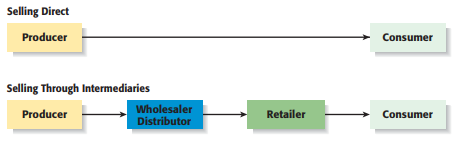
Place, or distribution, encompasses all the activities that move a firm’s product from its place of origin to the consumer. A distribution channel is the route a product takes from the place it is made to the customer who is the end user.
The first choice a firm has to make regarding distribution is whether to sell its products directly to consumers or through intermediaries such as wholesalers or distributors. Within most industries, both choices are available, so the decision typically depends on how a firm believes its target market wants to buy its product. For example, it would make sense for a music studio that is targeting the teen market to produce digital recordings and sell the recordings directly over the Web. Most teens have access to a computer or smartphone and know how to download music. In contrast, it wouldn’t make nearly as much sense for a recording company targeting retirees to use the same distribution channel to sell its music offerings. A much smaller percentage of the retiree market knows how to download music from the Web. In this instance, it would make more sense to produce CDs and partner with wholesalers or distributors to place them in retail outlets where retirees shop.
Selling Direct Many firms sell direct to customers. Being able to control the process of moving their products from their place of origin to the end user instead of relying on third parties is a major advantage of direct selling. Examples of companies that sell direct are Abercrombie & Fitch, which sells its clothing through company-owned stores, and Fitbit, which sells its exercise and sleep monitoring device through its Web site.
The disadvantage of selling direct is that a firm has more of its capital tied up in fixed assets because it must own or rent retail outlets, must maintain a sales force, or must support an e-commerce Web site. It must also find its own buyers rather than have distributors that are constantly looking for new outlets for the firm’s products.
The advent of the Internet has changed how many companies sell their products. Many firms that once sold their products exclusively through retail stores are now also selling directly online. The process of eliminating layers of middlemen, such as distributors and wholesalers, to sell directly to customers is called disintermediation.
Selling Through Intermediaries Firms selling through intermediaries typically pass off their products to wholesalers or distributors who place them in retail outlets to be sold. An advantage of this approach is that the firm does not need to own as much of the distribution channel. For example, if a company makes MP3 players and the players are sold through retail outlets such as Best Buy and Walmart, the company avoids the cost of building and maintaining retail outlets. It can also rely on its wholesalers to manage its relationship with Best Buy and Walmart and to find other retail outlets to sell its products. The trick to utilizing this approach is to find wholesalers and distributors that will represent a firm’s products. A start-up must often pitch wholesalers and distributors much like it pitches an investor for money to win their support and cooperation.
The disadvantage of selling through intermediaries is that a firm loses a certain amount of control of its product. Even if a wholesaler or distributor places a firm’s products with a top-notch retailer like Best Buy or Walmart, there is no guarantee that Best Buy or Walmart’s employees will talk up the firm’s products as much as it would if it had its own stores. Selling via distributors and wholesalers can also be expensive, so it is best to carefully weigh all options. For example, a firm that sells an item for $100 on its Web site and makes $50 (after expenses) may only make $10 if the exact same item is placed by a distributor into a retail store. The $40 difference represents the profits taken by the distributor and the retailer.
Some firms enter into exclusive distribution arrangements with channel partners. Exclusive distribution arrangements give a retailer or other intermediary the exclusive rights to sell a company’s products. The advantage to giving out an exclusive distribution agreement is to motivate a retailer or other intermediary to make a concerted effort to sell a firm’s products without having to worry about direct competitors. For example, if Nokia granted AT&T the exclusive rights to sell a new type of cell phone, AT&T would be more motivated to advertise and push the phone than if many or all cell phone companies had access to the same phone.
One choice that entrepreneurs are confronted with when selling through intermediaries is how many channels to sell through. The more channels a firm sells through, the faster it can grow. But there are problems associated with selling through multiple channels, particularly early in the life of a firm. A firm can lose control of how its products are being sold. For example, the more retailers through which Ralph Lauren sells its clothing, the more likely it is that one or more retailers will not display the clothes in the manner the company wants.
© Entrepreneurship (Book)