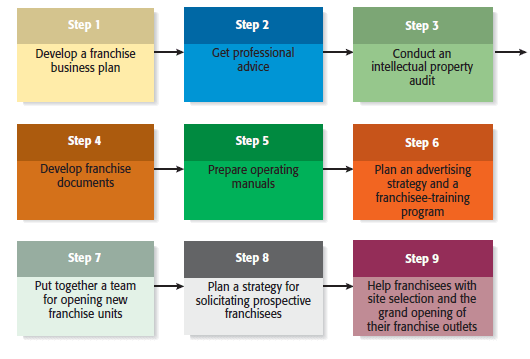
Let’s assume that as an entrepreneur you have decided to use franchising as a means of growing your venture. What steps should you take to develop a franchise system? You, as an entrepreneur, should take nine steps in order to successfully set up a franchise system.
Step 1 Develop a franchise business plan: The franchise business plan should follow the format of a conventional business plan and should fully describe the rationale for franchising the business and act as a blueprint for rolling out the franchise operation. Particular attention should be paid to the location of the proposed franchise outlet.
Step 2 Get professional advice: Before going too far, a potential franchisor should seek advice from a qualified franchise attorney, consultant, or certified public accountant. If the business cannot be realistically turned into a franchise, then a qualified professional can save a potential franchisor a lot of time, money, and frustration by urging that the process be stopped. If the business can be turned into a franchise, then it is advisable to get professional advice to help direct the entire process.
Step 3 Conduct an intellectual property audit: This step is necessary to determine the intellectual property a company owns and to ensure that the property is properly registered and protected. All original written, audio, and visual material, including operating manuals, training videos, advertising brochures, and similar matter, should be afforded copyright protection. If a firm has a unique business model that includes a unique business method, it should consider obtaining a patent for its business method. These protective measures are vital because once a company begins franchising, its trademarks and business model and any unique business methods are disseminated, making them more visible to customers and competitors. In addition, a franchisor should make sure that its trademark is not infringing on the trademark of any other firm.
Step 4 Develop franchise documents: At the beginning of the franchise evaluation process, a prospective franchisor should prepare the Franchise Disclosure Document (formally called the Uniform Franchise Offering Circular) and the franchise agreement. A franchise attorney can provide specific information regarding the content and format of these documents.
Step 5 Prepare operating manuals: Businesses that are suitable for franchising typically have a polished business system that can be fairly easily taught to qualified franchisees. The franchisor should prepare manuals that document all aspects of its business model.
Step 6 Plan an advertising strategy and a franchisee-training program: Prospective franchisees will want to see an advertising strategy and a franchisee-training program in place. The scope of each program should match the speed at which the franchisor wants to grow its business.
Step 7 Put together a team for opening new franchise units: A team should be developed and prepared to help new franchisees open their franchise units. The team should be well trained and equipped to provide the franchisee a broad range of training and guidance.
Step 8 Plan a strategy for soliciting prospective franchisees: There are many channels available to franchisors to solicit and attract potential franchisees. Franchise trade fairs, newspaper ads, franchise publications, social media platforms, and Internet advertising are examples of these channels.
Step 9 Help franchisees with site selection and the grand opening of their franchise outlets: Location is very important to most retail businesses, so a franchisor should be heavily involved in the site selection of its franchisees’ outlets. The franchisor should also help the franchisee with the grand opening of the franchise outlet.
Along with the specific steps, it is important for a franchisor to remember that the quality of the relationships it maintains with its franchisees often defines the ultimate success of the franchise system. It is to the franchisor’s advantage to follow through on all promises and to establish an exemplary reputation. This is an ongoing commitment that a franchisor should make to its franchisees.
**********************
franchisor is a company that owns a successful product or service and grants other businesses the right to use its trademark, brand, and business model.
Franchisees are the businesses that obtain this license, allowing them to operate under the franchisor’s established brand and guidelines.
© Entrepreneurship (Book)